



The Russian Ministry of Science and Higher Education’s “Winter University in Engineering Sciences” project has concluded, bringing together 660 students from 13 countries around the world. Over the course of two weeks, they studied at three universities in St. Petersburg, Veliky Novgorod, and Pskov. The participants created around 120 innovative projects aimed at advancing heavy engineering, digital technologies, artificial intelligence, electronics, and radio engineering.
The project is designed to strengthen ties between young engineers and deepen international cooperation. It serves not only as a learning platform but also as a catalyst for new ideas and future joint projects.
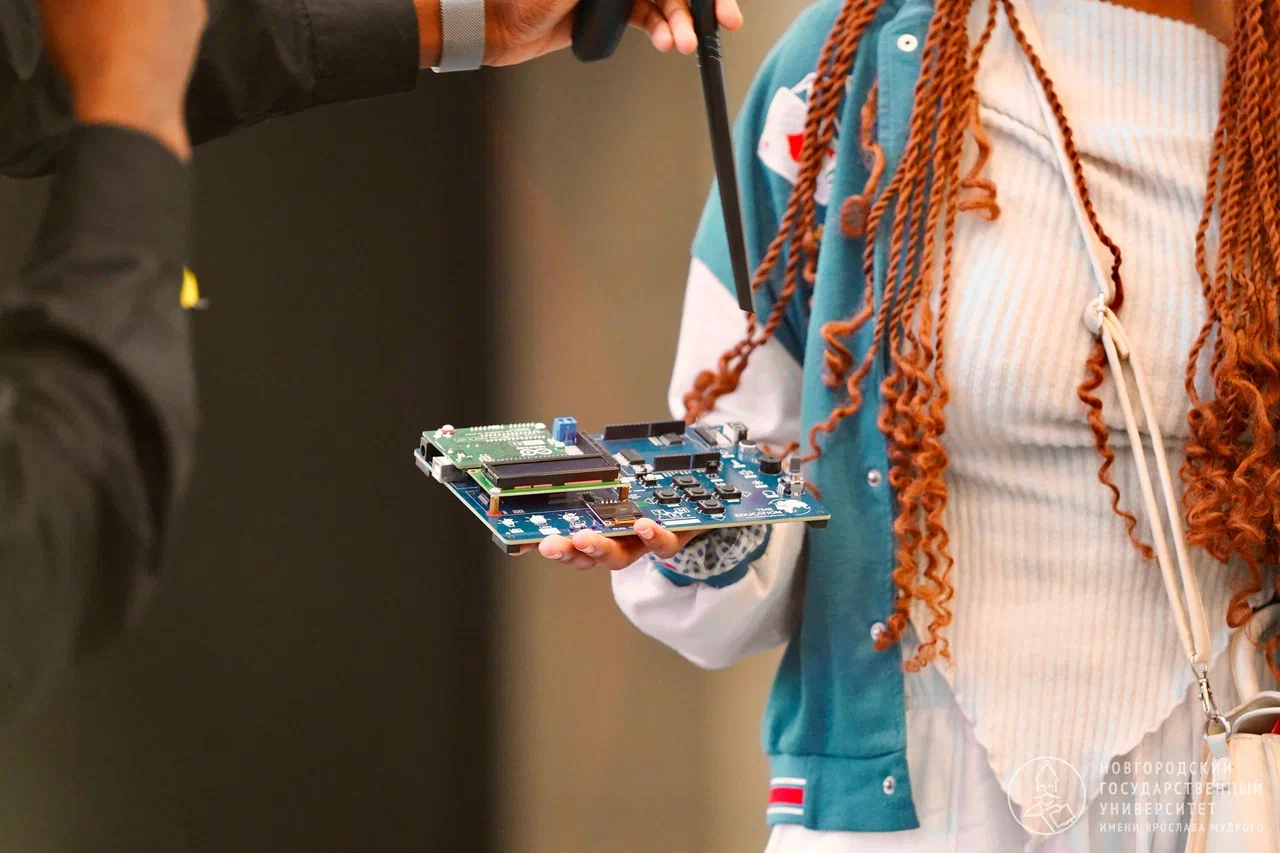
The “Winter University” at Novgorod State University brought together 220 future engineers from Russia, Belarus, South Africa, India, Kyrgyzstan, and Tajikistan. In total, the participants developed 24 projects, including a firefighting drone.
“The firefighting drone will help prevent a blaze before the fire service arrives. The UAV is equipped with powder-filled spheres that will be dropped into the flames. The design is intended for use in urban environments to extinguish fires in high-rise buildings, though it can also be used in other settings,” said Kamil Bektenov, a student of the Kyrgyz Aviation Institute named after Ishembai Abdraimov.
Another project was the “Smart Parking” system. It is designed so that sensors and video cameras detect the availability of parking spaces and whether cars are parked correctly, transmitting the information via neural networks to a dedicated app.
“The app will be available to regular users: when approaching the parking area, a driver will be able to choose a convenient spot, and the app will build a safe and convenient route to it. Thanks to this development, we will also be able to reduce the number of accidents that can occur in parking lots,” said Viktor Ivanov, a student of the Belarusian State University of Informatics and Radioelectronics.
The “Winter University” at Peter the Great St. Petersburg Polytechnic University was held at the university’s Advanced Engineering School “Digital Engineering.” Here, 220 students from Belarus, Kazakhstan, Kyrgyzstan, Uzbekistan, Armenia, Tajikistan, China, South Africa, Iran, and India took part in 70 projects.
In the project laboratory, students developed an efficient transmitter bracket for a CubeSat-format microsatellite on the CML-Bench® digital platform, using topology optimization, computer engineering, and 3D printing.
“The bracket project had specific operational requirements, including weight reduction while meeting strength requirements. The students were tasked with determining the optimal number of fastening holes available for use, as well as the location of the suspension point. All designs underwent digital testing and were ranked to determine the best implementation,” said Mikhail Zhmaylo, Head of Applied Research and Development at the Advanced Engineering School of SPbPU.
In the Laboratory for Digital Transformation and Lean Manufacturing, young engineers explored the concept of lean manufacturing, studied its approaches and tools for reducing losses, tried their hand as managers of a modern enterprise in the computer simulator “Lean Manufacturing” and carried out a digital transformation of an enterprise using the “Enterprise Digital Transformation” simulator.
In the “Polymer Composite Materials” laboratory, students enhanced their basic knowledge of polymer physics and chemistry.
At Pskov State University, 220 students and master’s students from Serbia, Bosnia and Herzegovina, South Africa, Uzbekistan, Belarus, and Russia took part. A total of 25 teams worked on projects in electrical engineering, robotics, electrotechnics, and diagnostic systems for technical devices and equipment.
The main training venues were the workshops and classrooms of PskovSU’s Advanced Engineering School. Among the projects developed here was a “Mobile autonomous robot for cleaning bulk and liquid waste in metalworking production environments.”
“This is a control unit for cleaning metal shavings in manufacturing. When a person cleans up shavings, they can injure their hands or scratch their face, because the shavings are metal and very sharp. For the robot, this is not a problem — it does all the work for people,” said Pavel Pumko, a student from Belarus.
It should be noted that the “Winter University” evolved from the “Union State School of Engineering Sciences,” which was held in 2023 for 300 students from Russian and Belarusian universities. This year, the project became truly international: the number of participants grew significantly, and the geography of the represented countries expanded.